|
The Ledger Letter
Finance Studio Advisors · Friday, June 12, 2026
|
|
Market Intelligence Partner
Something strange is happening to your money.
It wasn’t voted on. It wasn’t debated in the Senate. And most Americans have no idea it’s even taking place but…
Not with crypto. Not with a digital currency. Something far bigger than that – and it’s already been signed and sealed in the back rooms of D.C., ready to be issued by the U.S. Treasury.
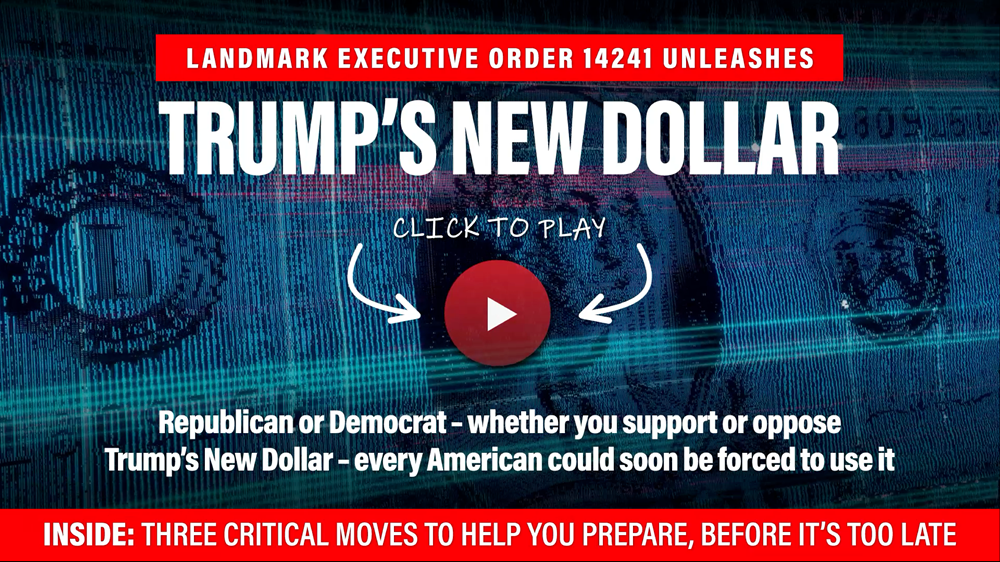
Bypassing every legal and political channel under the guise of “national security,” Trump has enacted this total money reset using a landmark executive order (1421).
Whether you’re a Democrat or Republican, whether you support this new money or not, it doesn’t matter.
Soon, every U.S. citizen will be forced to use Trump’s New Dollar to fill their gas tank, buy groceries, and pay medical bills. Which is why I’ve produced a critical new documentary laying out exactly what Trump’s New Dollar means for your savings, your investments, and your family’s financial future. Detailing three important steps you can take today to prepare – including the name of a core band of assets connected to Trump’s initiative that could surge as a result.
As you’ll see in my briefing, the last time America reset its money like this – under Richard Nixon’s presidency in the 1970s – it created one of the greatest wealth divides in the history of our nation.
On one side, it minted an average of 1,300 new millionaires a day for over half a century. And on the other… the folks left behind, drowning in debt, with no idea how to use America’s new money to create wealth.
As Trump rolls out his new dollar, the question is:
Good investing,
Porter Stansberry
PS. If you’re wondering what Trump’s new money will look like, when it will be issued, what it means for your investments – all of those questions are answered in my briefing.
|
$75 Billion Priced Last Night. The Rebalancing Starts Now.
SpaceX priced at $135 a share after the close Thursday. $75 billion raised. $1.75 trillion valuation. The largest initial public offering in history, by a factor of two. Trading begins this morning on the Nasdaq under SPCX. MSCI has already confirmed fast-track index inclusion within ten trading days, per Reuters. The funds tracking those indexes hold $5.79 trillion. They will be forced buyers of a stock with roughly 7 percent free float. That buying pressure has to come from selling something else. The S&P 500, which rebounded 1.8 percent Thursday on Iran deal hopes, is about to absorb the largest single-day capital reallocation event in market history.
|
|
The Breakdown
Today’s disagreement: the equity market is absorbing the largest offering ever recorded while wholesale inflation accelerates and the Fed weighs a rate decision in five days.
|
| 01 |
The Raise
SpaceX offered 556 million shares at $135, a $75 billion raise, per Reuters. Goldman Sachs led a syndicate of 21 banks. At $1.75 trillion, SPCX starts trading as one of the ten most valuable public companies in America. Roughly 30 percent of the offering was allocated to retail investors.
|
|
| 02 |
The Forced Buy
MSCI confirmed June 8 it will apply fast-track inclusion rules, per Reuters. SpaceX enters its Global Standard Indexes roughly ten trading days after listing. Passive funds tracking MSCI hold $5.79 trillion. Nasdaq and FTSE Russell have also cleared paths for rapid inclusion. Every index fund that adds SPCX has to sell existing holdings to make room.
|
|
| 03 |
The Squeeze
Only about 7 percent of SpaceX shares will be freely tradeable at launch, per Reuters. Shadow markets were pricing a first-day pop of 35 percent or more, per Bloomberg. Meanwhile, May PPI came in at 6.5 percent annually, the fastest in nearly four years, per the BLS. The FOMC meets in five days.
|
|
|
|
|
By the Numbers
| SpaceX IPO raise | $75 billion |
| IPO price / valuation | $135 / $1.75T |
| Public free float | ~7% |
| MSCI passive fund AUM | $5.79 trillion |
| May PPI annual | 6.5% (4-yr high) |
| S&P 500 (Jun 11 close) | +1.8% (rebound) |
Sources: Reuters, BLS, Bloomberg, MSCI. Figures reflect Jun 11 close and latest available data.
|
|
The Full Picture
Where $75 Billion Comes From
The Arithmetic
$75 billion is not new money. It left other positions. It rotated out of bond funds, equity holdings, money markets, and savings accounts. More capital deployed into one ticker on one day than most companies generate in a decade of revenue.
SpaceX reported $18.7 billion in 2025 revenue, per its S-1. It also reported a $4.9 billion net loss. S&P Global excluded it from quick S&P 500 inclusion specifically because it is not profitable, per Reuters. The market just valued a money-losing company at $1.75 trillion. Our view: that is not irrational. It is a bet on infrastructure monopoly. But the capital that made the bet came from somewhere.
The Index Machine
MSCI’s fast-track means inclusion within roughly ten trading days. Passive funds must accumulate shares in a 7 percent float. Every dollar they deploy comes from selling existing positions, proportional to market cap. MSCI published its own scenario analysis earlier this year warning that megacap IPOs in 2026 could trigger billions in rebalancing flows and increase tracking error across sectors.
Worth watching: the biggest selling pressure will fall on the sectors where SPCX does not compete. The rotation is mechanical, not discretionary. It happens whether fund managers want it to or not.
The Inflation Overlay
PPI at 6.5 percent annual puts wholesale price growth at its fastest since late 2022, per the BLS. Headline PPI ran at 1.1 percent monthly, above the 0.7 percent consensus, per Schwab. The FOMC sits next week. The 10-year yield steadied near 4.55 percent. In this tape, the market is absorbing a record equity offering on the same week it learned that producer costs are accelerating faster than expected.
What Your Portfolio Sees
If you own a Nasdaq index fund, you will own SpaceX by month-end whether you chose to or not. If you own a broad equity ETF, the rebalancing will shift your sector exposure. If you own individual names in the current index, some of them just became the funding source for someone else’s SPCX allocation.
The largest IPO in history is not just a company going public. It is a forced reallocation of capital across every passively managed portfolio in the country. The question is not whether you want exposure. The question is what got trimmed to pay for it.
|
$75 billion doesn’t appear from nowhere. It leaves one position and enters another. The question today isn’t whether SpaceX is worth $1.75 trillion. It’s what your index fund had to sell to find out.
|
|
|
The Ledger Letter
When markets disagree, the signal is in the disagreement.
|
|
This newsletter is for informational purposes only and does not constitute investment advice. Past performance is not indicative of future results.
|
|
|