The Ledger Letter Finance Studio Advisors · Saturday, July 11, 2026 |
Market Intelligence Partner | Share price deadline | $0.52/share |
|  | 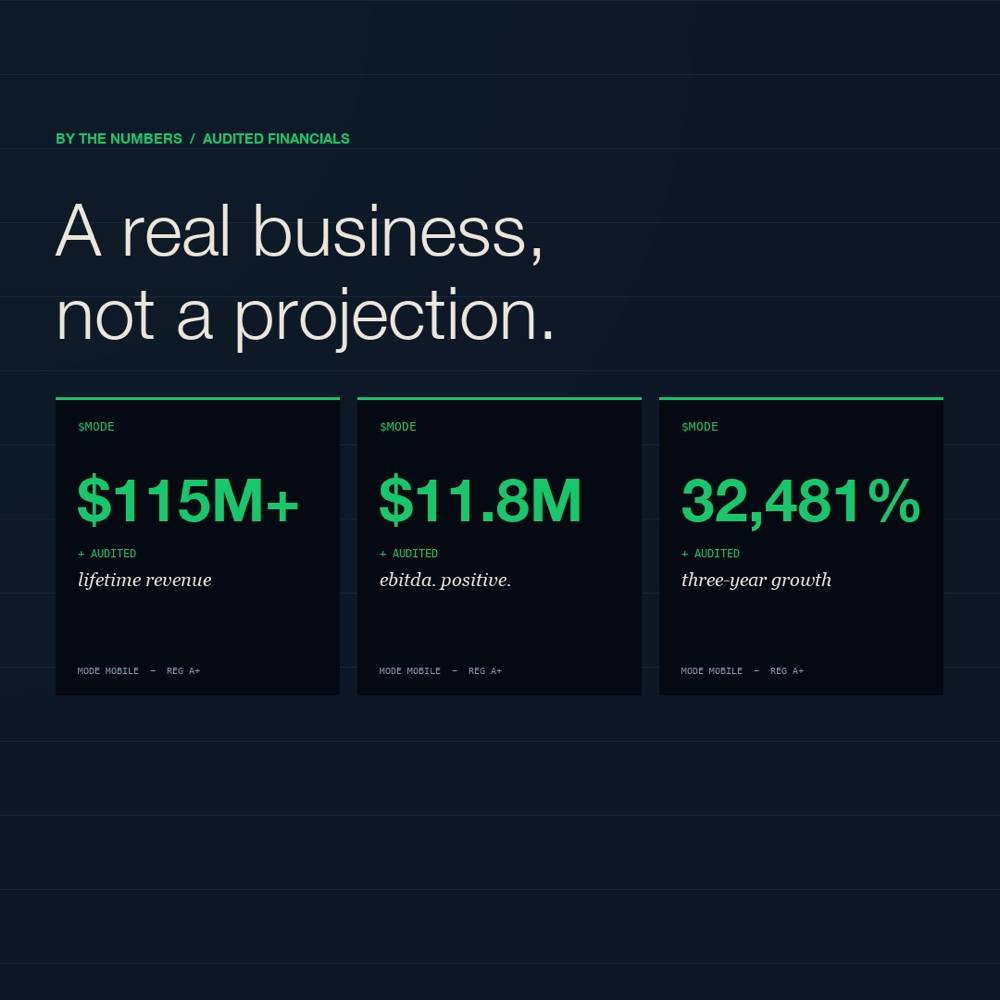 | By the numbers Most pre-IPO pitches are a promise. This one has audited numbers behind it. | 490M+ users across the ecosystem |
| $1B+ earned and saved by users |
| | 32,481% three-year revenue growth |
| #1 fastest-growing software co. in North America (Deloitte) |
| ~60,000+ investors already in |
|
| Shares in the Regulation A+ round are $0.52 each, with up to 20% bonus shares for early investors. The $0.52 share price deadline. The Nasdaq ticker $MODE is reserved ahead of a planned listing. | | See the full numbers › | invest.modemobile.com | This is a paid advertisement for Mode Mobile’s Regulation A+ offering. Please read the offering circular and related risks at invest.modemobile.com. Mode Mobile recently received their ticker reservation with Nasdaq ($MODE), indicating an intent to IPO in the next 24 months. An intent to IPO is no guarantee that an actual IPO will occur. The Deloitte rankings are based on submitted applications and public company database research, with winners selected based on their fiscal-year revenue growth percentage over a three-year period. *Mode revenue and EBITDA numbers includes full year revenue and EBITDA of businesses acquired in 2025. Investing involves a high degree of risk, including the possible loss of your entire investment. |
Advertisement · Mode Mobile |
Gold Just Passed Treasuries as the World’s Largest Reserve Asset. Nobody Noticed.Gold closed the week near $4,100, roughly 27 percent below its January all-time high of $5,589. Most coverage framed that as a correction. The reserve data tells a different story. According to ECB estimates cited by State Street, gold reached 27 percent of global official reserves at the end of 2025, surpassing United States Treasuries at 22 percent for the first time in the modern era. Central banks purchased 244 tonnes net in the first quarter of 2026 alone, above the five-year quarterly average. The People’s Bank of China added 15 tonnes in June, its 20th consecutive month of accumulation. Poland added 82 tonnes in the first half of the year. Western gold ETFs, meanwhile, recorded their largest quarterly outflow since 2023. Two capital allocation regimes are pricing the same metal. One buys the turn. The other sold the record. CPI on Tuesday decides which side has the next three months right. |
The Breakdown Today’s disagreement: reserve managers are accumulating gold at the fastest pace since 1967. Western fund investors are liquidating at the fastest pace since 2023. Both are looking at the same price, the same Fed, and the same inflation data. They have reached opposite conclusions. |
| 01 | The Structural Bid Central banks purchased roughly 244 tonnes of gold in Q1 2026 and averaged approximately 1,000 tonnes per year since 2022, per World Gold Council data. Goldman Sachs revised its central-bank demand estimate to roughly 60 tonnes per month through 2026. Physical bar and coin demand rose 42 percent year over year in Q1. The structural bid held through the entire correction from the January high. |
| | 02 | The Tactical Exit Western gold ETFs recorded their largest quarterly outflow since 2023 in Q1 2026. September hike odds sit near 63 percent. The 10-year yield is at 4.55 percent. At that yield, cash and Treasuries compete directly with a metal that pays nothing. The tactical flow follows the rate math. The structural flow ignores it. |
| | 03 | The Reserve Shift Gold reached 27 percent of global official reserves at the end of 2025, surpassing U.S. Treasuries at 22 percent for the first time, per ECB estimates. That inversion did not happen because gold rallied. It happened because reserve managers decided, collectively, that dollar-denominated paper held abroad can be frozen. Gold cannot. |
|
|
| By the Numbers | Gold Share of Global Reserves (2025) | 27% (UST: 22%) | | Gold (Fri close) | ~$4,100 | | Decline from January ATH ($5,589) | ~27% | | CB Net Purchases Q1 2026 | 244 tonnes | | PBOC (Jun 2026) | +15 tonnes (20th month) | | Poland (H1 2026) | +82 tonnes | | Goldman Sachs Year-End Target | $5,400/oz | | June CPI Release | Tue, July 14, 8:30 AM ET |
Sources: ECB via State Street, World Gold Council, Goldman Sachs, SAFE (PBOC), CME FedWatch, BLS. Data as of July 10–11, 2026. |
Two Capital Regimes. One Metal. One CPI Print.Why Reserve Managers Are Buying the Correction The structural case for gold changed in 2022. The freezing of roughly $300 billion in Russian central-bank assets demonstrated that dollar-denominated reserves held abroad can be immobilized overnight. Gold cannot. Reserve managers across the developing world absorbed that lesson and began a reallocation that is now three years old and accelerating. China’s PBOC has purchased gold every month for 20 consecutive months. Its June addition of 15 tonnes was the largest since December 2024. Gold still represents only about 8.8 percent of China’s total reserves. If China were to bring that figure to even 15 percent, the tonnage required would be measured in thousands. Poland added 82 tonnes in the first half of 2026 alone, bringing its total reserves to roughly 550 tonnes. Kazakhstan, Brazil, and India have all been active buyers. The World Gold Council estimates central banks will purchase roughly 850 tonnes in 2026. Why Western Capital Is Leaving In this tape, Western investors are running the opposite trade. Gold ETFs recorded their heaviest quarterly outflow since 2023 in Q1 2026. The logic is straightforward: when the 10-year Treasury pays 4.55 percent and September hike odds sit near 63 percent, the opportunity cost of holding a non-yielding asset rises with every basis point. The rate math pushes capital out of gold and into cash, Treasuries, and money-market funds. That flow is tactical. It responds to the next dot, the next CPI print, the next 25 basis points. It is rational on a 90-day horizon. But reserve managers do not allocate on 90-day horizons. They allocate on 30-year horizons. And on that timeline, the question is not whether the Fed hikes in September. The question is whether the dollar retains its share of global reserves as U.S. federal debt crosses $39 trillion and the share of foreign official holdings in Treasuries continues to decline. The Number That Changed Our view: the most important number in the gold market is not the price. It is the 27 percent. ECB estimates show gold reached 27 percent of global official reserves at the end of 2025, surpassing United States Treasuries at 22 percent for the first time. That crossover is the product of a decade of accumulation by emerging-market central banks and a parallel decline in foreign official demand for U.S. government debt. This is not a price prediction. It is a statement about how the world’s reserve managers have already voted with their balance sheets. Gold did not need to rally to surpass Treasuries. Reserve managers bought it through corrections, through rate-hike cycles, and through the sharpest selloff since 2022. That is structural conviction, not a trade. What CPI Decides Worth watching: June CPI releases Tuesday, July 14 at 8:30 a.m. Eastern. May headline CPI was 4.2 percent year over year, with energy accounting for over 60 percent of the monthly increase. If the June print cools, September hike odds fall, the dollar softens, and the tactical sellers reverse. Goldman’s year-end target of $5,400 and J.P. Morgan’s $6,000 forecast both depend in part on that repricing. If the print runs hot, the tactical pressure on gold extends and the structural bid absorbs more supply at lower prices. Either way, reserve managers are not waiting for the print. They have already decided. |
Gold passed Treasuries as the largest global reserve asset while trading 27 percent below its high. Central banks bought the correction. Western ETFs sold it. The reserve shift is not a forecast. It already happened. The only question left is whether the tactical flow catches up to the structural flow or stays on the other side of it. Tuesday’s CPI print sets the direction for the next quarter. |
| The Ledger Letter When markets disagree, the signal is in the disagreement. | This newsletter is for informational purposes only and does not constitute investment advice. Past performance is not indicative of future results. |
|
|