Finance Studio Advisors · The Ledger Letter
The Index Says Diversified. The Holdings Say Otherwise.
The S&P 500 is up. Nvidia reports Wednesday. Leveraged ETF assets just hit a record $177 billion. Retail is positioned for a continuation. The index looks healthy from the outside. Inside, 34.8% of it is seven companies — and the leverage betting on those seven companies has never been higher. That combination deserves attention before the market gets a binary test.
The Breakdown
01 The Concentration
The Magnificent Seven now account for approximately 34.8% of the S&P 500 by market cap. Semiconductors have gone from roughly 2% of the index a decade ago to around 18% today. A retail investor who bought a standard S&P index fund and called it diversification is, functionally, heavily concentrated in AI infrastructure and the companies that build it.
02 The Leverage
Assets in leveraged ETFs just hit a record $177 billion. These products reset daily and amplify both gains and losses. When concentration and leverage peak simultaneously before a binary catalyst — Nvidia reports Wednesday — the margin of safety on the long side thins considerably. A miss doesn’t just move Nvidia. It moves the index.
03 The Consumer
Credit card delinquencies 90 days or more past due reached 13.1% — the worst severe delinquency reading since the aftermath of 2008, per Federal Reserve data. The AI rally and the consumer stress are running simultaneously. Markets are pricing the first. The second hasn’t been priced yet.
Partner Perspective
Editor’s note: The AI concentration story above has a flip side — the names getting overlooked while everyone watches the Mag 7. Our partners at Brownstone Research are tracking one of them now.
|
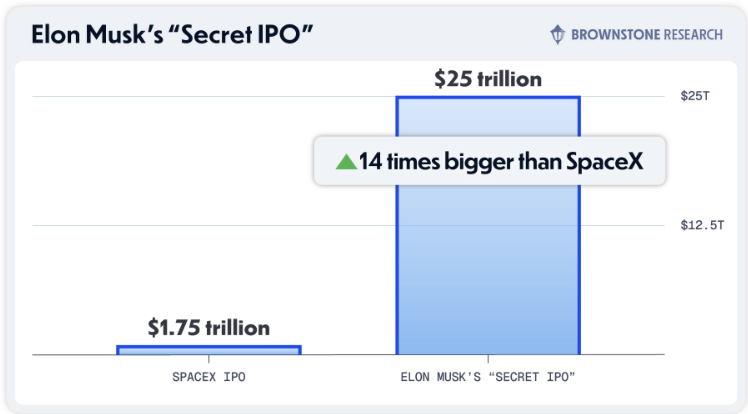
Editor’s Note: Former tech executive Jeff Brown was one of the first to predict SpaceX’s IPO, long before it became the biggest investment story of 2026. He’s been a believer in Musk’s companies from the start — even when most were skeptical. When many were proclaiming the death of Tesla, Jeff doubled down. And it’s up 1,800% since. Now he says Musk is up to something very exciting — a brand-new company that could be worth over $25 trillion. And it’s not SpaceX. Click here for the details or read more below. Dear Reader, While everyone is distracted by SpaceX… They’re missing a far bigger story… And more immediate opportunity. It’s what we call Elon Musk’s “Secret IPO.”
A brand-new company with a potential value of $25 trillion. That’s 14 times more than SpaceX… And you can get in right now. On the ground floor. Before an announcement by Musk makes this secret IPO front page news. Click here to learn how you can claim your stake — today. Regards, Jeff Brown |
By the Numbers
What the index is not showing you.
| Metric | Figure |
| Mag 7 share of S&P 500 | ~34.8% |
| Semiconductors share of S&P 500 | ~18% (vs ~2% a decade ago) |
| Leveraged ETF assets | $177B (record) |
| Credit card delinquencies 90+ days | 13.1% (worst since 2008) |
Why It Matters for Your Money
Passive indexing was designed to reduce stock-picking risk. It works when the index is broadly diversified. When 34.8% of the index is seven companies, passive investing becomes concentrated investing with an index label on it. The investor who bought “the market” owns a large AI infrastructure bet, whether they know it or not.
This matters more on a week when Nvidia reports. A strong beat extends the thesis. A miss — or even soft guidance — doesn’t just reprice Nvidia. It reprices the narrative across every concentration name. The passive investor feels it all.
The Wealth Angle
Leveraged ETF assets at $177 billion means a significant portion of the market’s daily volume is driven by products that reset daily and mechanically buy on the way up. They also mechanically sell on the way down. When leverage is highest, reversals are sharpest — not because of fundamental reassessment, but because of mechanical deleveraging. The retirement account that didn’t buy a leveraged ETF still gets repriced by everyone who did.
Credit card delinquencies at 13.1% — worst since 2008’s aftermath — tell you the household balance sheet has been absorbing this rate environment for longer than the market has been pricing it. Consumer credit doesn’t move the index on a Tuesday. It moves earnings estimates of the companies selling to those consumers six months later.
The Key Insight
The market is pricing the AI infrastructure cycle. It is not yet pricing the demand destruction on the other side of the consumer balance sheet. Both are real. Only one is in the multiple.
The Smart Money Move
Pull up your largest holdings. If your top three positions are all in the same AI concentration trade — directly or through index funds — you’re not diversified. You’re concentrated in one thesis with different ticker symbols on it.
Worth watching Wednesday: not just whether Nvidia beats, but whether guidance implies the AI capex cycle has another year of runway or is beginning to plateau. The market has been pricing the first. The second would require a significant repositioning across names that now make up nearly a fifth of the index alone.
Our view: concentration doesn’t resolve at the top. It resolves when the thesis gets tested or when leverage forces it. Neither scenario is catastrophic. Both require portfolios that were built with the concentration in mind.
The index says diversified. The holdings say 34.8% in seven companies. Before Nvidia reports, those are not the same statement.
Finance Studio Advisors
Precision in every paragraph. Financial communication built for clarity, credibility, and action.
This newsletter is for informational purposes only and does not constitute investment advice. Past performance is not indicative of future results. Always conduct your own research and consult a qualified financial advisor before making investment decisions.