|
Finance Studio Advisors
|
The Ledger Letter
|
|
|
One Post Moved Oil 15%. The Volatility Itself Is the Risk.
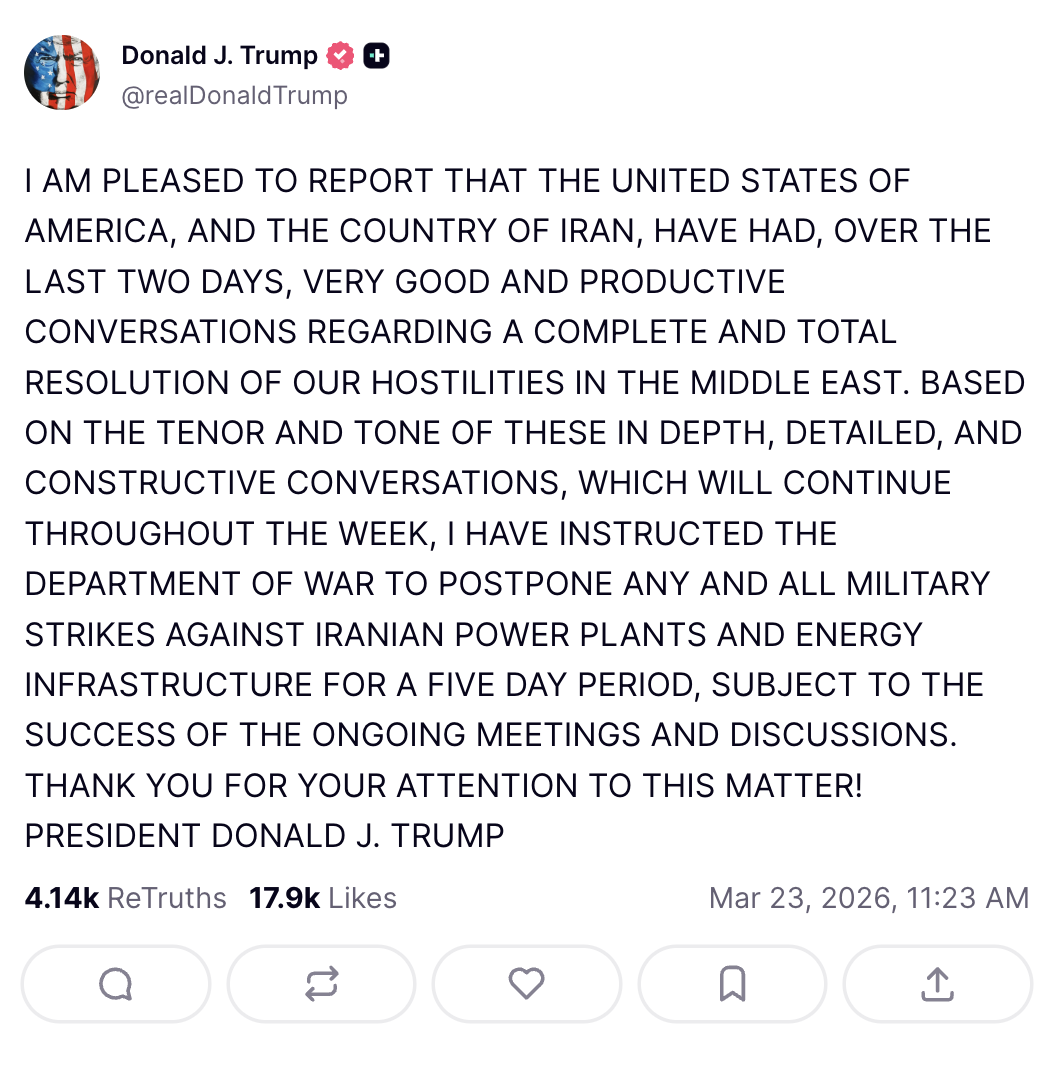
Brent crude swung from $114 to below $92 this morning after Trump announced a five-day pause on strikes and cited “productive” talks with Iran. A single social media post just erased three weeks of price gains in minutes. That kind of volatility is the real portfolio risk.
|
|
The Breakdown
|
|
01. Trump announced “productive” talks with Iran and a five-day delay on power plant strikes. Brent crashed roughly 15% within minutes — its largest intraday swing of the conflict — briefly touching $92 after closing near $106 Friday.
|
|
02. The S&P 500 entered Monday with four consecutive weekly losses, RSI below 30, and the index near 6,500 — an oversold reading that historically precedes near-term bounces. The oil drop may accelerate that move.
|
|
03. Rate expectations remain unstable. Last week, Fed Governor Waller reversed his rate-cut stance, citing the war's inflationary impact. Futures had priced a 50% chance of a rate hike. If oil stays lower, that math changes again.
|
|
|
|
The post that moved oil 15% in minutes.
|
|
|
|
|
The Full Picture
|
When a Single Post Reprices an Entire Asset Class
|
|
Consider the past 72 hours. Saturday night, Trump threatened to “obliterate” Iran's power plants if Hormuz wasn't reopened by Monday evening. Brent spiked to $114. Iran's Defense Council responded by threatening to mine the entire Persian Gulf and target energy infrastructure across the region. Then this morning, Trump posted that the two sides have had “very good and productive conversations” and delayed all strikes for five days. Brent dropped 15% in minutes. That's a $20+ per barrel swing driven entirely by two social media posts — not supply data, not inventories, not OPEC decisions.
|
|
What that means practically: the Strait of Hormuz is still not open. Iran hasn't confirmed any talks. The IEA's 400-million-barrel emergency release — the largest in history — has barely moved prices. The underlying supply disruption hasn't changed. What changed is sentiment. And sentiment-driven moves of this magnitude create real problems for anyone running leveraged positions, hedging with energy exposure, or holding growth stocks priced for a rate path that keeps shifting week to week. JPMorgan's S&P 500 year-end target sits at 7,200 with a downside case of 6,000. Goldman sees 5,400 in a severe oil shock. Both forecasts were published before this morning's reversal. The structural question remains: are we watching de-escalation, or just another lull before the next headline? Until that's clear, position sizing matters more than direction.
|
|
|
Finance Studio Advisors
Precision in every paragraph. Financial communication built for clarity, credibility, and action.
|
|